For many people with ADHD, knowing what needs to be done isn’t necessarily the problem. It’s getting started, staying organised and following through.
Everyday tasks such as preparing meals, managing appointments, completing household chores or keeping up with work can become overwhelming. What may appear to be a simple task can involve several steps that require planning, attention, organisation and time management.
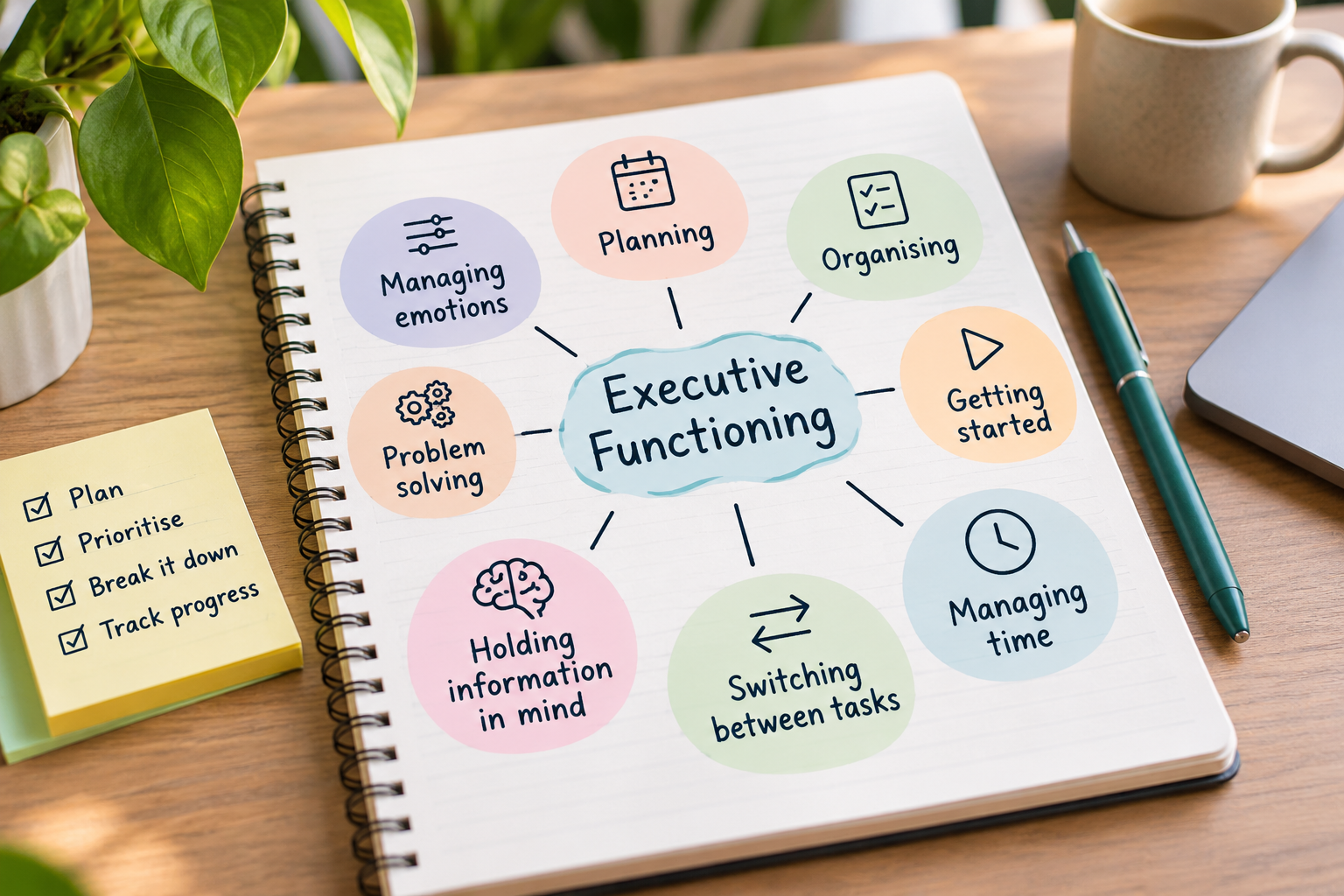
These difficulties are often associated with executive functioning, a group of cognitive skills that play an important role in how we manage our daily lives.
Occupational therapy for ADHD focuses on understanding how these challenges affect a person’s ability to participate in everyday activities and developing practical strategies that work for them.
What is executive functioning in ADHD?
Executive functioning refers to a group of cognitive skills that help us plan, organise, initiate tasks, manage our time, regulate our emotions and adapt to changes.
We rely on these skills throughout the day, often without realising it.
For example, getting ready for work involves remembering what needs to be done, estimating how much time each task will take, organising belongings and leaving the house on time.
For someone with ADHD and executive functioning difficulties, completing this routine may require considerably more effort.
Executive functioning challenges are commonly associated with ADHD but can also occur in people with autism, acquired brain injuries, psychosocial disabilities and other neurological conditions.
Worth remembering
It’s important to recognise that these difficulties do not necessarily reflect a person’s motivation, intelligence or willingness to complete a task.
How can an occupational therapist help someone with ADHD?
Occupational therapists focus on how a person’s condition affects their ability to participate in meaningful everyday activities.
Rather than focusing solely on an ADHD diagnosis, an occupational therapist considers the person’s strengths, challenges, environment and individual goals.
For adults with ADHD, this may involve difficulties with maintaining routines, completing household responsibilities, managing finances, participating in education or meeting workplace expectations.
ADHD occupational therapy may focus on developing daily living skills, improving task initiation, establishing routines and identifying strategies to support greater autonomy in everyday life.
ADHD occupational therapy assessments and functional capacity
Occupational therapy intervention typically begins with an assessment to understand how ADHD and executive functioning difficulties affect the person’s daily life.
This may involve discussing their current routines, identifying activities they find challenging and exploring strategies they have previously tried.
Depending on the person’s needs, an occupational therapist may use standardised assessments, clinical observations and practical task-based activities to gain a clearer understanding of their functional abilities.
Understanding where these difficulties occur allows therapy to focus on the areas where support is most needed.
For individuals accessing the NDIS, a Functional Capacity Assessment (FCA) may also be recommended to document how their disability affects everyday functioning and identify relevant support needs. NDIS eligibility and funding depend on individual circumstances and are not determined by an ADHD diagnosis alone.
4 practical ways occupational therapy can support executive functioning
Developing routines and daily structure
Establishing and maintaining routines can be particularly challenging for people with ADHD.
Although calendars, planners and reminder applications can be useful, they are not always effective for everyone.
An occupational therapist works collaboratively with the person to identify strategies that are realistic and suited to their lifestyle. This may include:
- Developing morning and evening routines.
- Using visual schedules or checklists.
- Breaking larger activities into smaller steps.
- Establishing consistent times for daily tasks.
- Organising the home environment to make frequently used items easier to access.
The focus is on developing routines that can be maintained over time rather than introducing complicated systems that become difficult to follow.
Improving task initiation and time management
One of the common executive functioning challenges associated with ADHD is task initiation, which refers to the ability to begin an activity.
A person may understand exactly what needs to be done but still experience difficulty getting started.
Similarly, difficulties with time awareness can affect a person’s ability to estimate how long activities will take, transition between tasks or meet deadlines.
Occupational therapy may involve introducing ADHD time management strategies such as visual timers, task breakdowns, structured schedules and environmental prompts.
These strategies can help reduce the cognitive demands associated with planning and completing everyday activities.
Managing finances, appointments and household responsibilities
Executive functioning difficulties can also affect a person’s ability to manage everyday responsibilities.
This may include remembering appointments, paying bills on time, managing paperwork, completing household chores or keeping track of important information.
An occupational therapist can support the development of practical systems to manage these responsibilities.
Strategies may include establishing a weekly administration routine, setting up appointment reminders, creating budgeting templates or developing household management checklists.
The aim is to reduce the demands associated with remembering, organising and completing multiple responsibilities while supporting the person’s ability to manage their daily living activities.
Supporting participation in work and education
Executive functioning plays an important role in both employment and education.
Difficulties with attention, organisation, planning and time management can affect a person’s ability to complete assignments, manage workloads, follow instructions or meet deadlines.
An occupational therapist can assess the demands of the person’s work or study environment and identify strategies to support participation. This may include:
- Developing structured work or study schedules.
- Introducing organisational tools and task management systems.
- Identifying strategies to minimise distractions.
- Breaking complex tasks into manageable steps.
- Recommending environmental modifications or reasonable adjustments.
Where appropriate, occupational therapists may also collaborate with employers, educators or other professionals to support the implementation of these strategies.
Working with families and support networks
For some people, involving family members, carers or support workers can be an important part of occupational therapy for ADHD.
This is particularly relevant when a person requires assistance to establish routines or consistently implement strategies between therapy sessions.
An occupational therapist may provide education and practical recommendations to help support networks understand the person’s executive functioning difficulties and how best to assist them.
The focus remains on promoting the person’s autonomy, building their skills and ensuring that the support provided aligns with their individual goals.
Frequently asked questions about ADHD and occupational therapy
Can an occupational therapist help adults with ADHD?
Yes. Occupational therapists can support adults with ADHD who experience difficulties with executive functioning, daily routines, organisation, time management and participation in everyday activities. Intervention focuses on identifying practical strategies tailored to the person’s functional needs and goals.
Can occupational therapy improve executive functioning?
Occupational therapy can help people develop strategies to manage executive functioning difficulties. This may involve using visual supports, establishing routines, adapting environments and practising approaches to planning and task completion. The focus is on improving everyday functioning rather than eliminating ADHD symptoms.
Can an occupational therapist diagnose ADHD?
Occupational therapists do not typically provide a formal ADHD diagnosis. In Australia, ADHD diagnosis is undertaken by appropriately qualified health professionals. Occupational therapists assess how ADHD affects daily functioning and provide practical interventions to address identified challenges.
Is ADHD occupational therapy covered by the NDIS?
Some people with ADHD may be eligible for NDIS support if they meet the scheme’s disability and eligibility requirements. An ADHD diagnosis alone does not automatically qualify someone for NDIS funding. Where occupational therapy is related to a participant’s disability support needs and meets NDIS funding requirements, it may be included in their plan.
Is occupational therapy right for someone with ADHD?
Not everyone with ADHD will require occupational therapy. However, it may be beneficial when executive functioning difficulties are affecting a person’s ability to manage daily activities, maintain routines or participate in work, education and community life.
Occupational therapy is not about expecting everyone to function in the same way.
It is about recognising individual differences, understanding the barriers a person experiences and identifying practical strategies that support their participation in everyday life.
At REM Healthcare, we provide person-centred occupational therapy assessments and interventions tailored to each person’s functional needs and goals.
Whether you are seeking support with daily routines, executive functioning or functional capacity assessments, our occupational therapists can help identify practical strategies to support your everyday life.
Contact REM Healthcare
If you are looking for ADHD occupational therapy support in Melbourne, contact REM Healthcare to discuss your needs and how our occupational therapy services may assist.
Call (03) 7056 9960 to speak with our team.